February 2011
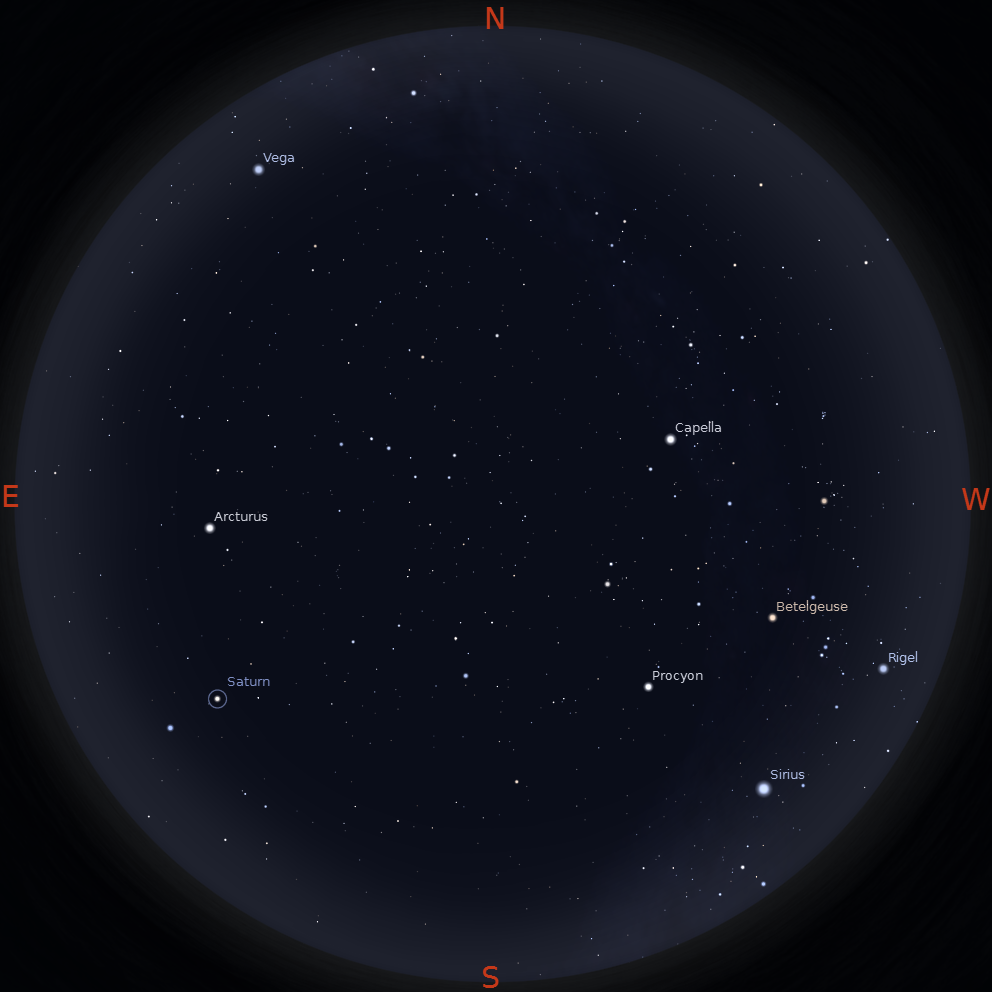
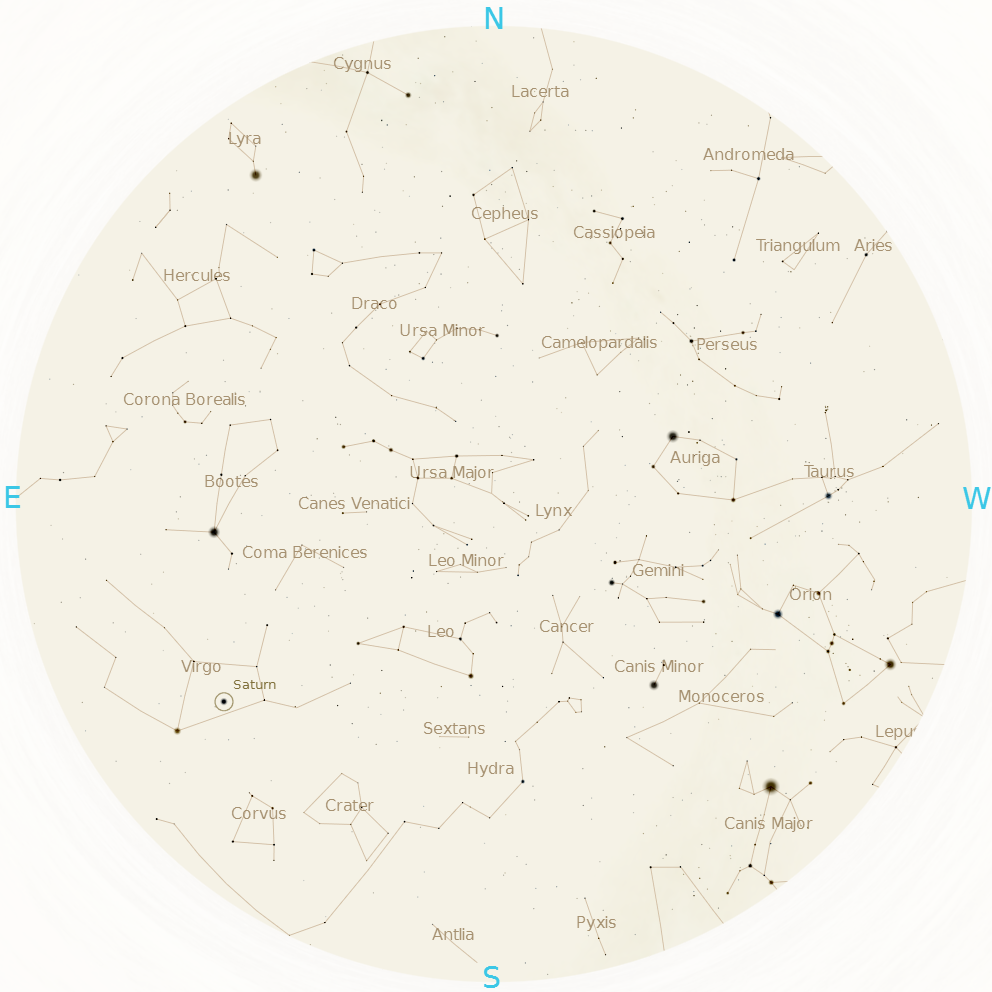
The night sky as seen at 01:00 on the 1st of February, Midnight on the 14th and at 23:00 on the 28th
If anyone is waiting for an email reply from me, please check your junk email folder as I have been made aware that some of my emails are incorrectly identified as spam. I only ever send emails as a reply to ones that I have received.
The cardinal points of the compass show the view of the horizon in that direction. For example, if you printed out the image below, to see the stars facing north, you would rotate the picture so that N is on the bottom. The stars will then line up with the actual stars in the sky when looking north.
Mercury is not visible this month.
Venus rises by about 05:20 at the beginning of the month and is visible as a bright star in the south eastern sky before sunrise. Although not as high in the sky before sunrise as in January, Venus remains a bright star in the south eastern sky before sunrise, however becoming low in the sky by the end of the month.
Mars is obscured by the Sun and so is not visible this month.
Jupiter continues to be the brightest object in the sky after sunset, to the south west, eventually setting in the west by 21:00. As the month progresses Jupiter moves towards the west after sunset, eventually setting by 20:00 by the end of the month.
Saturn rises in the east just after 22:45 at the beginning of the month and is easily visible by midnight, approaching the south east. Saturn continues to rise in the sky, travelling across the southern sky to the south west before being blotted out by the rising sun. By the end of the month Saturn is rising in the east by about 20:45. It is easily visible now in the late evening and continues to be visible throughout the early morning until sunrise.
Orion still continues to dominate the southern sky during the evening. M 42 in Orion's sword is visible to the unaided eye as a star with slight nebulosity surrounding it. Through binoculars the nebula is easily visible and combined with the other stars in Orion's sword, makes a spectacular view.
Follow the line of Orion's belt down to Sirius the brightest star in the sky in the constellation of Canis Major. The whole of the Canis Major is above the horizon and this is the best month to view it. M 41 in Canis Major is an open cluster that is just visible to the unaided eye. It is just below Sirius. Follow a curve up from Sirius and we find Procyon in Canis Minor. Almost half way between Sirius and Procyon is M50 in Monoceros. This is an open cluster that is visible through binoculars. Continue the curve upwards from Procyon and we come to Pollux and Castor in the constellation of Gemini. M 35 in Gemini is an open cluster easily visible in binoculars. Continue the curve and we arrive at Capella in the constellation of Auriga. Auriga contains three open clusters M 36, M 37 and M 38, all of which are visible through binoculars.
Also best placed for observation this month are the constellations Lepus and *Columba.
There are no major meteor showers this month.
The images of the night sky on this page are produced using Stellarium, a free open source planetarium for both the PC and the Mac. It can be downloaded free from http://www.stellarium.org/